
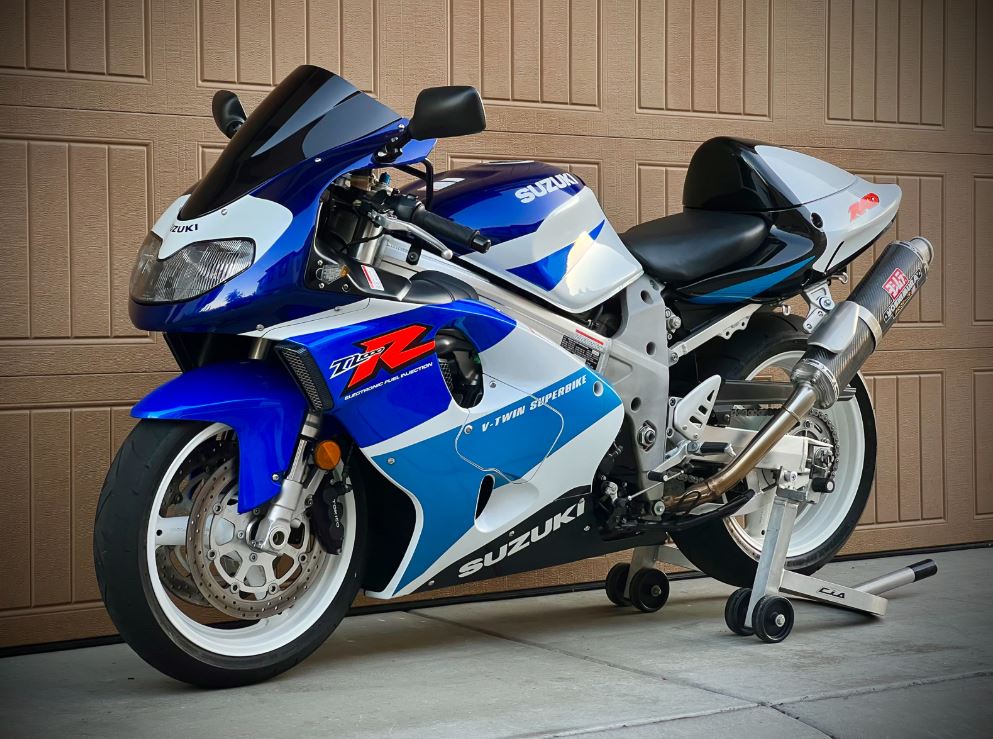
Click here for an VINData Motorcycle History Report on this 1998 Suzuki TL1000R.

Following the success of Ducati’s V-Twin-powered racers in the World Superbike Championship, other major manufacturers followed suit by developing their own race-bred V-Twins. Suzuki’s first attempt at a performance-driven V-Twin model came in the form of the TL1000S in 1997, though the next year the Japanese marque would follow up the half-faired 1000S with the even racier TL1000R. “The concept behind the TL1000R is simple: Build a V-Twin with the potential to win Superbike races”, explained Hiroshi Moritake who led the TL-R project.

While the 1000S and 1000R models both shared the same engine, the R-spec was far more than just a full-faired version of its predecessor. The 1000R featured a beefy aluminum twin-spar frame based on the GSX-R750. The frame was complemented by a new braced swingarm, a standard steering damper, and a revised version of the 1000S’s notoriously finicky rotary damper spring unit with new linkages.

The V-Twin motor was also updated for the TLR, getting a revised ram-air-box, Mikuni electronic dual-injector throttle bodies, upgraded cams, forged pistons, beefier connecting rods, improved ignition timing, and a 1,000 rpm higher redline. The changes to the liquid-cooled, four-stroke, 996cc, 8V, DOHC, 90-degree V-Twin ultimately afforded the TLR a cool 135hp at 9,500 rpm and 78 ft-lbs of torque at 7,500 rpm. And despite the bump in performance, the V-Twin retained its reputation for bullet-proof reliability. The Gixxer-derived chassis was paired with a 43mm inverted fork, and both the front and rear suspension are adjustable for spring preload, rebound, and compression damping. Slowing the twin-cylinder superbike was a pair of 320mm front discs bit by six-piston calipers and a single 220mm disc with a dual-piston caliper in the rear — all provided by Tokico.

Weighing around 430 lbs dry, the TL1000R sported wind-tunnel-developed bodywork including a distinctive “shark nose” fairing, which helped the 135 hp V-Twin cut through the air and reach speeds of up to 170 mph. Suzuki also offered a myriad of trick factory race kit parts for the TLR, including upgraded internals, and a wide array of chassis adjustability such as swing-arm pivot position, ride height, and steering stem rake.

Manufactured May 1998, this example is VIN: JS1VT52A3W2101847.

During his ownership, the seller has covered 4 miles. The odometer shows 6,390 miles.

Per the VIN report, this bike was originally sold in July of 1998 in California. The next owner acquired it in an estate sale and “loved the bike but he wants something he won’t feel guilty riding and putting miles on.” The seller is assisting the owner and is “now helping him locate a clean BMW R NineT.”

Maintenance:
The seller states, “Fuel pump gasket leaks are common on these bikes, this one apparently had one but has since been repaired. No leaks of any kind at the moment.”
Modifications:
Yoshimura RS-3 exhaust.

Hotbodies fender eliminator undertail.

Aftermarket lower profile front turn signals, aftermarket tinted windscreen.

Tank protector.

Swingarm spools.

The “SUZUKI RAM AIR DIRECT” stickers on the tail have been removed and the “SRAD” stickers on the tail have been modified to say “RAD”.

Inside of the tank:

It is riding on Bridgestone Battlax tires with date codes of 2312 and 0313.


The sale includes one key.

Cosmetic Blemishes: please see the album up top for all known cosmetic blemishes. Here is a selection:
The seller notes a “marker tip sized chip on gas tank. Very small.”


Currently located in Murrieta, California, this Suzuki is offered on a clean Arizona title. Have any TL-R stories or questions about this listing? Let us know in the “Comments” tab!


