
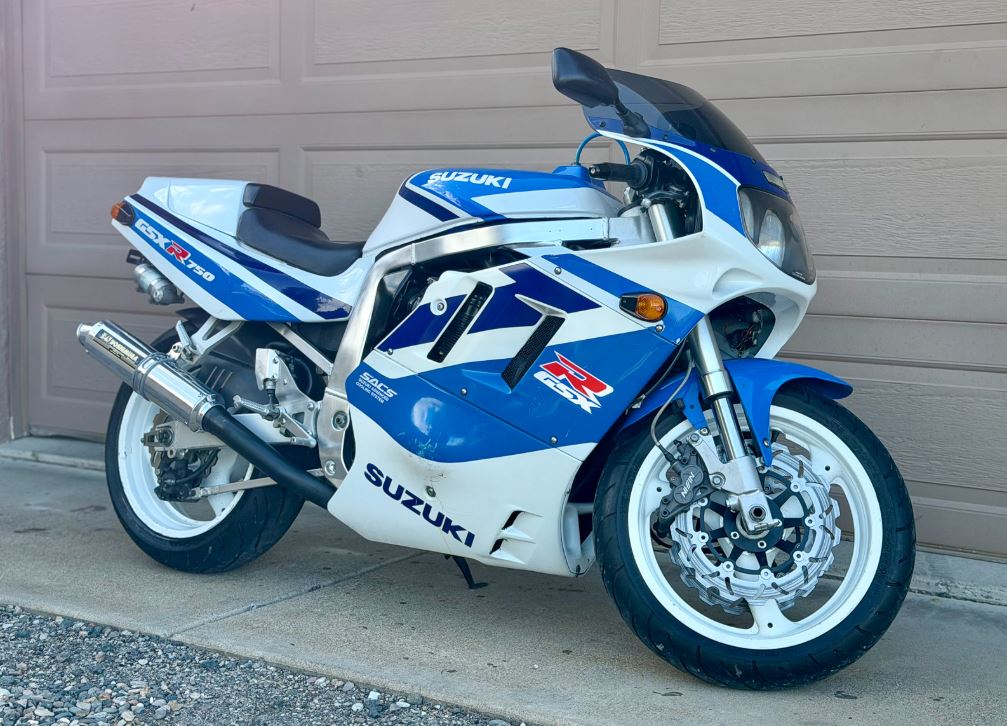
Suzuki pulled the cover off the first-year GSX-R750 (model code: F) at the 1984 Cologne Motor Show, before its official launch in March of 1985. Upon its release, the Gixxer was unquestionably king, setting a new benchmark in the industry. And unsurprisingly, it didn’t take long for the GSX-R to start winning on the race track. The new model won the 1985 TT with rider Mick Grant, while a young Kevin Schwantz straight up dominated the Transatlantic series. In the subsequent years, the mighty Gixxer saw a number of revisions before 1990, when the three-quarter-liter beast was given a major model update. That year, Suzuki bestowed the GSX-R750 with a host of features borrowed from the race-spec double-R model (GSX-R750R), including its long-stroke engine layout, lighter pistons, new Mikuni model BST38SS “Slingshot” carbs, upgraded connecting rods and cylinder head, smaller valves, a revised stainless four-into-two-into-one exhaust culminating in a single muffler mounted on the right side, and new suspension that yielded increased adjustability.

Come 1991, the ‘Zook was given its first significant visual makeover, getting a new tail section, less rectangular-shaped side vents in the bodywork, and a new front fender was introduced to better accommodate the inverted front-end (though that last feature didn’t extend to US models). The biggest change for ’91 was undeniably its new front fairing design. Gone were the original Suzuka-style double headlight arrangement, and in its place was a slanted nose fairing that hid headlights several inches behind a clear headlight cover, giving the bike a more aggressive and contemporary appearance while also bolstering aerodynamics. On top of also getting a new, larger seat, ’91 marked the final year of the oil-cooled SACS-engined version of the Gixxer.

Powering the 1991 Gixxer 750 was an air/oil-cooled, 749cc, 16V, DOHC, inline-four, married to a six-speed constant mesh transmission. All the changes resulted in an output of 116 hp at 11,000 rpm and 57.5 ft-lbs of torque at 10,000rpm, which translated to top speed exceeding 150 mph and the ability to fire off standing quarter mile sprints in under 11 seconds — despite its approximately 550 lb wet weight.

This example is VIN: JS1GR7AA9M2100252. The seller acquired it in January 2026 from a private party in Phoenix, Arizona.

During his ownership, the seller has covered 150 miles. The odometer shows 24,382 miles. The seller installed a replacement speedometer “because of a broken needle/pointer the speedometer showed 21,350 miles at the time of replacement”.


The seller notes that when he purchased the bike “it was in need of carb work it had been sitting for a couple of years. I am selling because I want to out more focus into restoring my 1990 GSX-R1100.”
Maintenance:
“Replaced carbs with new Mikuni RS flat slides
Changed oil
Replaced mirrors
Replaced the speedometer (had a broken needle) have it to give to new buyer
Changed spark plugs
Replaced very ugly Vance and Hines exhaust with more era correct Yoshimura unit
It runs really strong, there are no mechanical issues that I am aware of.”
Modifications:
Mikuni RS38 flatslide carbs. “The Mikuni carbs have a very heavy throttle return spring.”

Yoshimura exhaust.

Tinted windscreen.

Braided brake lines, wave rotors front and rear.

Aftermarket turn signals.

Inside of the tank:

It is riding on Continental ContiMotion tires which have aged out with date codes from the year 2017.

The sale includes 1 ignition key, the pillion seat, the original speedometer/odometer, and some spare parts.


Cosmetic Blemishes: please see the album in the “Photos” tab for all known cosmetic blemishes. Here is a selection:
“The tail tank and mid fairings are B condition. The lower belly pan has rash and some cracks and upper fairing has a crack. The fairings have been painted. I would recommend a full repair and respray of the fairings and tank.”


Currently located in Cottonwood, Arizona, this Suzuki is offered on a clean Arizona title. Have any GSX-R750 stories or questions about this listing? Let us know in the “Comments” tab!


