
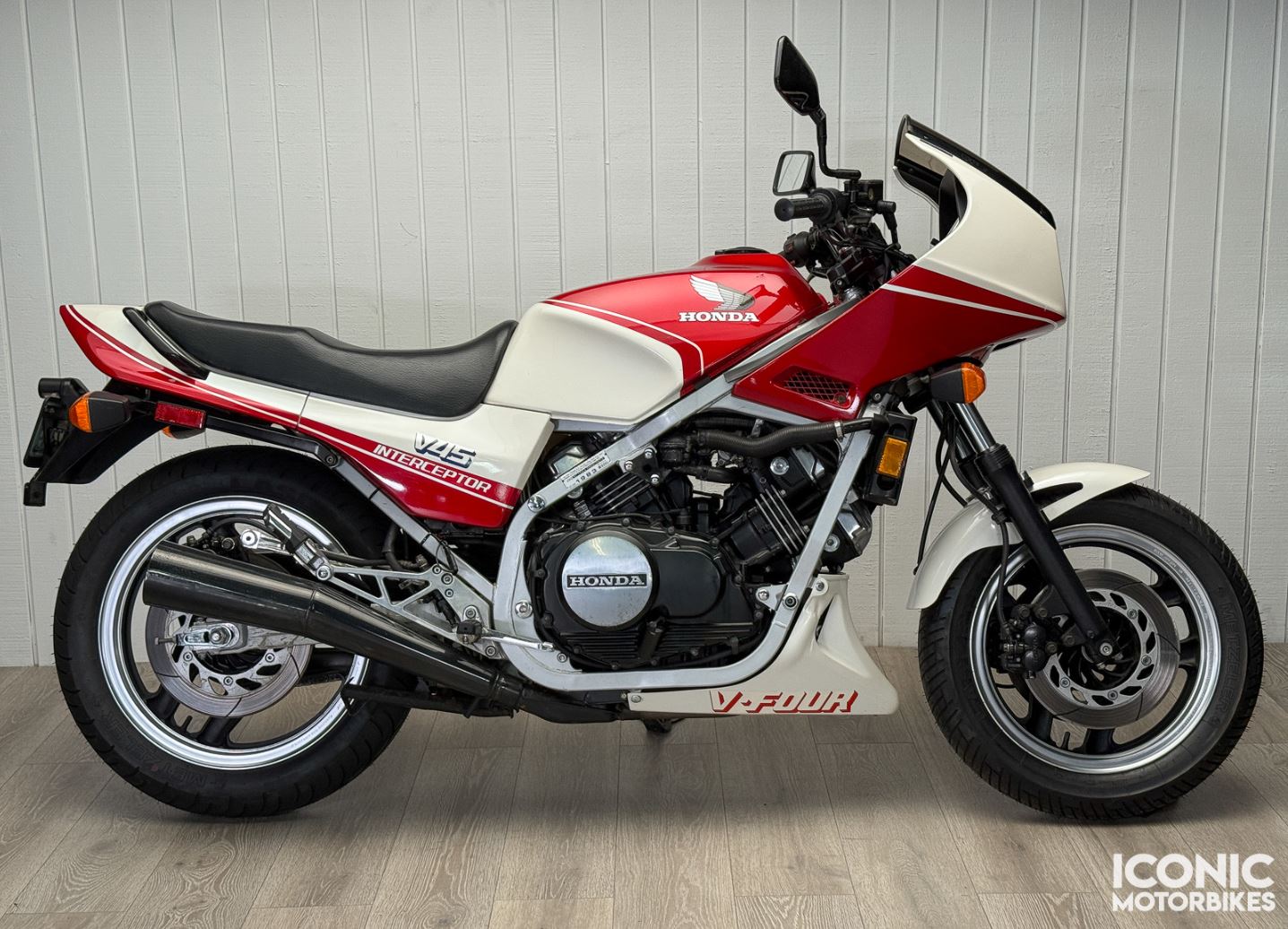
The original CB750 made Honda a serious force to be reckoned with, but a decade or so after its release, its fellow Japanese manufacturers had caught up and Honda’s dominance in the market was waning. Big Red’s answer unexpectedly came in the form of a new V4 platform. A year after the Sabre and Magna models were released in the US in 1982, Honda replaced the shaft-driven V4’s with the much sportier VF750F Interceptor. The new V4 was born out of new AMA regulations in 1983. That year, the American Motorcycle Association’s Superbike class announced it’d be limiting the displacement of four-cylinder bikes from 1000cc’s down to 750, and requiring all entries to be production models using the stock chassis. Despite being based on the (V45) Sabre, the Interceptor was a race replica through and through. The bike was built around its own competition-derived twin-spar alloy frame equipped with a cross-braced front-end and cast alloy swing-arm. The thing also sported ComCast aluminum alloy wheels — with a 16-inch unit in front — and dual-piston calipers biting floating discs.

Suspension was comprised of pieces developed by Showa and Honda with air-assist forks using Honda’s TRAC (Torque Reactive Anti-dive Circuit) system and its Pro-Link setup paired with one of Showa’s air-assist shocks. Fully adjustable at both ends, the Interceptor’s suspenders could be dialed in to suit a particular rider and/or track. Powering the Interceptor was a tweaked version of the Sabre’s power plant: a liquid-cooled, 748cc, 16V, DOHC, 90-degree V4 engine with gear-driven cams, four valve-heads, and 10.5:1 compression. Fed through four 30mm Keihin carbs, the V4 made a claimed 86hp at 10,000rpm and 52 ft-lbs of torque at 7,500rpm, weighed around 550lbs wet, and had a top speed of almost 135mph.

The VF’s engine was mounted directly onto the chassis, unlike its predecessor’s rubber-mounted setup. Revised combustion chambers and cam timing afforded the V4 a few extra ponies over the Sabre, and how that power got to the rear wheel was a whole other story as well. The VF used a five-speed gearbox instead of the Sabre’s six-speed, supposedly done to make adapting a chain final drive setup easier. The model’s transmission also featured a trick new slipper clutch.

Adhering to the 1983 AMA regulations ultimately prompted Honda to produce its first-ever road-legal race-replica production model — a type of motorcycle Honda still produces to this day. The VFs in showrooms were also extremely similar to the machines being campaigned by Honda’s factory racers. That was a major selling point for the bike, as it started dominating the competition right out of the gate. In its debut season in 1983, eight of the fourteen Nationals were won on the VF750F.

Manufactured in March of 1983, this example is VIN: JH2RC1503DM007902.

The odometer shows 4,376 miles.

The seller purchased this bike in February 2019, “a nostalgia purchase from someone who found it in SoCal after many years of storage (notice the blue plate), rode it once and parked it.” He is clearing out a few bikes and has sold the following through Iconic in the last month or so:
2016 Honda RC213V-S #96
1999 MV Agusta F4 750 Serie Oro
2020 Bimota Tesi H2
2006 Yamaha R1 LE #428
1973 Kawasaki Z1
Maintenance:
In preparation for the listing, the seller had us perform a safety inspection. Our service department notes the following on their condition report:
Gas Tank Internal Condition: Ok
Engine Oil Level: LITTLE HIGH
Engine Oil Quality: AGE UNKNOWN
2T Oil Level: N/A
Coolant Level: Ok
Coolant Quality: AGE UNKNOWN
Front Hydraulic Fluid Level: Ok
Front Hydraulic Fluid Quality: FAIL, >3% Moisture
Rear Hydraulic Fluid Level: Ok
Rear Hydraulic Fluid Quality: FAIL, >3% Moisture
Clutch Hydraulic Fluid Level: Ok
Clutch Hydraulic Fluid Quality: FAIL, >3% Moisture
Final Drive Condition: Ok, LITTLE DIRTY
Headlight High Beam: Ok
Headlight Low Beam: Ok
Passing Light: N/A
Parking Light: Ok
Turn Signals: Ok
Tail Light: Ok
Brake Light (Front Switch): Ok
Brake Light (Rear Switch): Ok
Plate Light: Ok
Horn: Ok
Kill Switch: Ok
Brake Pad % Remaining Front: 75%
Brake Pad % Remaining Rear: 80%
Forks: Ok
Shock/s: Ok
Tire Date Code Front: 22/18
Tire Date Code Rear: 29/18
Tire % Remaining Front: 99%
Tire % Remaining Rear: 99%
Tire Press. Front: 32 PSI
Tire Press. Rear: 36 PSI
Battery Standing Voltage: 12.97V
Charging Voltage @ 4k RPM: Unknown
Running Condition: Runs poorly on bench
Test Ride Completed: None taken
Test Ride Distance: N/A
Tires Installed:
Front: 120/80-16
Rear: 130/80-18
Notes:
-Mild rust marks in tank
-Too a while to fire up after draining float bowls.
Needs carb service as [it] doesn’t run cleanly and barely off choke
-Rear brake is sized
-Cosmetic Imperfections:
-Small dent with paint chips, RH fuel tank
-RH engine cover marked
-Nicks on RH fairing upper
-Big paint chips on LH, top of fuel tank
-Screen stained
-Small chips on fairing upper, front
-Aluminum fork brace is oxidized
-Exhaust have moderate oxidation n black coating
Recommended Repairs:
-Carbs
-Carb rubbers
-Engine oil and filter
-Coolant
-Hydro 3
-Rear brake service
-Tires
Modifications:
Battery tender lead.

Inside of the tank:

It is riding on Metzeler Lasertec tires with date codes of 2218 and 2918.


The sale includes one key.

Cosmetic Blemishes: please see the album in the “Photos” tab for all known cosmetic blemishes. Here is a selection:


Currently located in Panorama City, California, (please make an appointment for an inspection) this Honda is offered on a clean California title with registration current through May 2020.

The California DMV estimates that it will cost $827 to make registration current through May 2026.

Have any VF750F Interceptor stories or questions about this listing? Let us know in the “Comments” tab!
